
Without the Saturation Protocol
This is the Reality for the Legal Industry
The 18 Second Pulse...Did you Feel it?
In the time it took you to read that headline, a bot probed your website for a vulnerability. It happens 4,800 times a day.
Most service businesses are driving a "Digital Minivan"
These aren't random stats...the March and May core Google Updates are Legal Firms between $5 to $15k to recover and some are down for months...how much is that costing you?
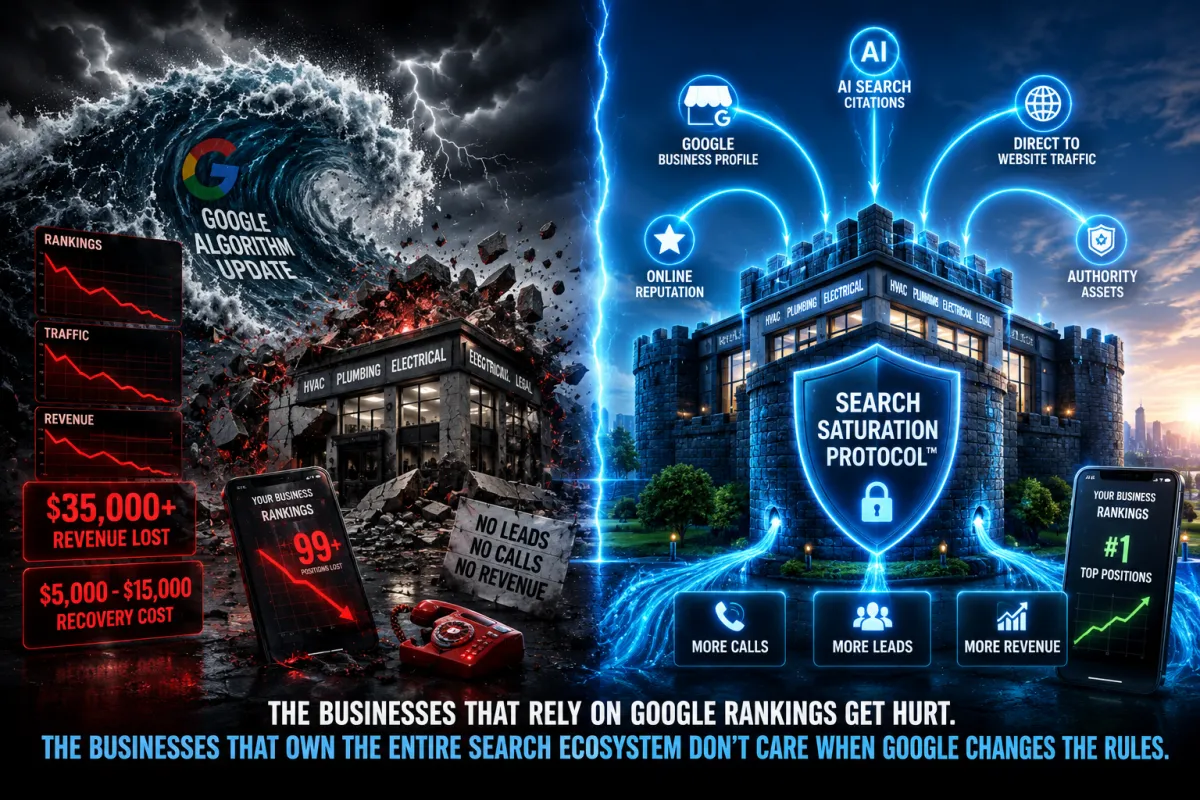
THE FORENSIC PROOF: According to the 2026 Small Business Revenue Leakage Study and the Scorpion State of Home Services Report, the "Performance Gap" between a legacy business and a digitally-hardened infrastructure is now 21-35% of total gross revenue.
For the average $1.5M service business, this equates to a $35,000 monthly loss—revenue that was effectively earned but never collected due to infrastructure failure.
The Missed Call Baseline ($10.5k/mo)
The Stat: 62% of incoming calls to small businesses go unanswered (Aira).
The Math: This costs the average service business $126,000 per year in lost revenue PCN Answers).t List 2
The Reckoning: That is $10,500 every single month vanishing just because the phone didn't ring in the right place.
The Loss: Without a Revenue Command center, you are losing 80% of your potential sales
The Stat: Responding to a lead within 1 minute increases conversions by 391% compared to waiting just 2 minutes AInora). If you wait 5 minutes, you are 21x less likely to close the deal (LeadHero).
Speed to Lead Decay ($15k/mo)
The Stat: You lose 71% of your pipeline if you don't respond within 5 minutes.
The Math: In 2026, the Scorpion State of Home Services Report shows a massive "performance gap" where businesses with automated triage see 21% higher average revenue than those without (Scorpion).
The Reckoning: For a business doing $1M/year, that’s a $210,000/year penalty for having a slow "respiratory system." That’s $17,500/mo in lost growth.
The Stat: 80% of searches now end in a "Zero-Click" (ClickVision
The Math: Traffic to non-hardened sites dropped by 15-30% following the March/May 2026 Core Updates (Digital Applied).
The Reckoning: You might "survive" on old referrals for a while, but you are part of the 70% of businesses that will shut down within 5 years because you couldn't bridge the digital divide (SellersCommerce).
Think We're Kidding?
Here's are Just a Handful of your Neighbours that have Gone Down
If your Business gets hit, the Chances of you Surviving more than 6 Months are Near Zero!
London Public Library (2023): Hit by a massive ransomware attack that shuttered all systems for weeks, disabling everything from book loans to public internet.
Town of St. Marys (2022): Targeted by the LockBit syndicate. The municipality was forced into a "pre-digital" state for months while investigators tracked the theft of sensitive data.
Bluewater Health (Sarnia, 2023): Part of the "TransForm" massacre where health records for 267,000 patients were stolen, leading to catastrophic liability.
Windsor Regional Hospital (2023): Critical diagnostic systems (CT/X-ray) were knocked offline, forcing emergency patients to travel hours for life-saving care.
Hôtel-Dieu Grace Healthcare (Windsor): Crippled in the same breach, proving that "Shared Service" models are a single point of failure (a "Respiratory Failure" for the network).
Erie Shores HealthCare (Leamington): Another casualty of the 2023 regional hospital strike, where small facilities were prioritized as easy targets.
Chatham-Kent Health Alliance: The fifth hospital in the "SWO Hospital Massacre," costing the collective organizations over $7.5M just to begin recovery.
City of Woodstock (2019): A virus attack locked municipal servers for weeks, costing taxpayers $667,000 in recovery fees—a massive "Status Quo Tax."
Woodstock Police Service: Hit simultaneously with the city, proving that even "secure" law enforcement is vulnerable to the 18-Second Pulse.
Oxford County (2025/2026): Reported a massive infiltration where legacy server vulnerabilities allowed hackers to access resident data.
Western University / Ivey Business School: Targeted through a third-party software vulnerability (the "Minivan" of software stacks), exposing thousands of student records.
Middlesex-London Health Unit (2024): Forced to shut down its entire phone and computer network, cutting off critical public access during a cybersecurity incident.
Code Spaces: A service-based hosting company that was deleted from existence in 12 hours after a hacker gained access to their control panel.
Lincoln College: After 157 years in business, this service-based educational institution shut down permanently in 2022 following a ransomware attack.
TravelEx (Finance Service): Once a dominant global currency exchange, it was forced into administration and sold after a ransomware attack paralyzed its systems for months.
MediSecure (2024): A major e-prescription service that went into voluntary administration and shut down after a massive data breach involving millions of records.
Vastaamo (Psychotherapy): A large chain of mental health clinics that went bankrupt and closed after hackers leaked thousands of patient therapy notes.
Discord.io (2023): A specialized service for Discord users that shut down permanently after a massive database breach.
Nirvanix: A cloud storage service that was forced to liquidate and gave customers just 2 weeks to move petabytes of data before the lights went out.
AMCA (Medical Billing): The American Medical Collection Agency filed for Chapter 11 bankruptcy after a breach exposed the records of 20 million patients.
Bitfloor: A service-based exchange that shut down after a heist stole its operational capital, proving that when the cash is gone, the service is dead.
Wood Ranch BBQ (Operational Hit): While not fully closed, they faced a terminal blow to their reputation and massive settlements after a data breach involving thousands of customers.
Heritage Village (Home Care): Faced months of "Grave Revenue" decay after a breach knocked out their patient scheduling—the "Lungs" of their business.
Scripps Health: A multi-billion dollar service provider that saw its revenue drop by $112M in a single month after a breach, nearly causing a total systemic collapse.
The Risk of Being Compromised (The Final Reckoning)
If you are running a service business without the Saturation Protocol, you are gambling with a statistical death sentence.
The 60% Rule: 60% of small businesses that suffer a cyberattack or significant data breach go out of business within 6 months (Cybersecurity Ventures).
The Recovery Black Hole: Even if you "survive," the average recovery time is 3 to 6 months. During that time, your leads vanish, your reputation burns, and your revenue hits zero.
The Financial Death Blow: The average cost of a data breach for an SMB in 2026 is $120,000—not including the loss of lifetime customer value.